You must be 21 years or older to enter this site. Please verify your age to continue.
You must be 21 years or older to enter this site. Please verify your age to continue.
Everything worth knowing before, during, and after your first order — dosing, effects, legality, lab testing, and the honest answers to the questions people actually ask.
No questions match that search. Try a different word, or email us.
They are closely related but not identical. THCA is the acidic form — tetrahydrocannabinolic acid — and it is what the living plant actually produces. THC as most people know it is what THCA becomes when heat is applied, a reaction called decarboxylation.
That relationship is why the two get discussed together and why lab reports list both.
Why the labelling matters legally. The 2018 Farm Bill defines hemp by its delta-9 THC content — not more than 0.3% by dry weight. THCA is measured separately. A product can therefore carry a substantial THCA figure while its delta-9 reading stays under the federal threshold, which is the basis on which THCA products are sold.
What to look at on the COA. A report will show a THCA number and a delta-9 number as separate lines, plus a "total THC" figure calculated as delta-9 plus roughly 0.877 times the THCA. That 0.877 accounts for mass lost in the conversion. Reading those three numbers together tells you far more than the front of any package — ours included — and our guide walks through how.
Worth knowing: total THC is the figure that determines where we can ship. It is why eleven states are off the list regardless of the delta-9 reading.
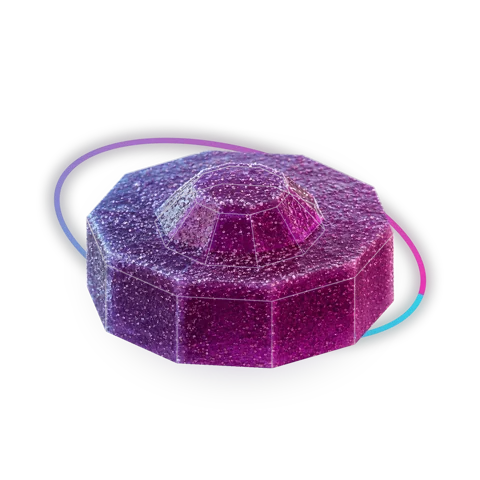
A COMET is our format: a single precision-crafted gem rather than a bag of small gummies. Each one is moulded with faceted score lines so it breaks cleanly into roughly equal portions.
One gem holds the full cannabinoid content on the package. A 100mg THCA COMET divided along its facets gives approximately 10mg per portion — no scale, no guesswork, no cutting board.
Why a single gem instead of ten small gummies? Two reasons. Consistency: cannabinoid distribution across a batch of small gummies varies more than most brands admit, so the 10mg piece you take today may not match tomorrow's. One larger piece, cast at once, distributes more evenly. And control: ten fixed 10mg pieces give you ten fixed doses, whereas facets let you take five milligrams, or seven, or twenty-five.
Each gem is roughly 6.5g and 6mL. The practical consequence is that a whole COMET is not a serving — it is ten of them, and it is designed to be divided.
All three are the same format, the same size and the same price, so the choice is about cannabinoid profile rather than value.
One honesty note on Stellar Sleep: CBN's reputation as "the sleep cannabinoid" outruns the evidence. The study most often cited as proof actually found CBN alone was not significantly sedating. We formulate with it because there is a plausible mechanism and customers ask for it — not because it is established. We set out the full picture in does CBN actually help you sleep, and would rather you read that than take the category's word for it.
Here is the honest answer: the evidence is thinner than the marketing across this industry suggests.
More on how cannabinoids differ →
CBN forms as THC ages and oxidizes. Its sedative reputation traces largely to older research where CBN was studied alongside THC rather than on its own, which makes it hard to separate the two. More recent work on CBN specifically is early and limited.
What we can say is that many people report CBN-containing products as noticeably restful, and that combining cannabinoids may matter more than any single one. We are not going to tell you it is a proven sleep aid, because that claim would outrun the science.
Sugar, corn syrup, water, gelatin, citric acid, sodium citrate, natural flavours, fruit and vegetable juice for colour, and the hemp extract itself. The exact list is printed on every package and on the product pages.
Allergen and dietary notes, since these come up:
Sugar content is meaningful — these are confectionery, and we would rather say so than describe them as a wellness product. If you have a specific allergy that is not covered above, email us before ordering and we will check the current batch specification rather than guess.
Keep them in a cool, dark, dry place with the package sealed. Heat and direct light degrade cannabinoids over time — the same oxidation process that gradually converts THC into CBN.
Avoid a hot car, a sunny windowsill, or a steamy bathroom cabinet. Refrigeration is fine but not required; if you do refrigerate, let the package reach room temperature before opening to avoid condensation.
Check the best-by date on the package. Potency declines slowly past that point rather than becoming unsafe, but texture and flavor suffer.
Not yet. Both are in progress, and we have published the standards we are holding them to before there is anything to buy — which is a slightly odd order to do things in, but it is the honest one.
The flower page covers the dry, the cure and the storage targets. The concentrates page covers the cold chain and the extraction methods. Both have a notification list, and joining it is the fastest way to hear when a batch is listed.
We are not giving a launch date, because the timeline is set by how long the cure takes and how fast the lab turns around, and neither compresses just because a date has been announced.
It is grown without synthetic pesticides, herbicides or chemical fertilizers. We are deliberately not printing the word "organic" on it, and it is worth explaining why, because plenty of brands do.
"Organic" is a term the USDA regulates. Applying it to an agricultural product without holding the certification is enforceable by the USDA directly, and separately by the FTC as an unsubstantiated claim. Hemp is eligible for that certification. We have not completed it, so we do not get to use the word.
What backs the claim up instead is the pesticide and heavy metal panel on every batch COA, which you can read yourself. An adjective costs nothing to type; a lab panel costs money and can embarrass you. When we hold the certificate we will say so and show it.
A minimum of two weeks in sealed vessels at 62% relative humidity, burped on a schedule, and usually closer to four.
It matters more than almost anything else. During the cure, residual chlorophyll and plant sugars break down — that process is what removes the grassy, hay-like smell people associate with cheap flower. The gas vented during burping includes ammonia produced as that material degrades, which is why burping is not optional.
The stage before it matters just as much. We dry at roughly 60°F and 60% RH for ten to fourteen days. Drying fast under heat dries the outside of the bud before the inside, trapping chlorophyll and moisture where no amount of curing will reach them, and it boils off the lightest terpenes permanently.
The full set of targets, including moisture content and water activity, is published on the flower page.
They want different things, so it is worth separating them.
The two enemies are the same in both cases. Heat drives the conversion of THCA toward CBN over time, changing the character of the product. Light — UV especially — destroys a terpene profile faster than anything else, which is why clear jars under a bright shop light are a merchandising decision rather than a storage one.
Storage and shelf life goes into more detail, including how long you can realistically expect a product to stay good.
Solventless uses ice, water, heat and pressure and nothing else — that is bubble hash and rosin. Solvent extraction uses hydrocarbons such as butane or propane to strip the resin from the plant, which are then purged out of the finished product.
The honest answer on which is better: neither, automatically. A properly purged hydrocarbon extract that passes its residual solvent panel is a clean product, not a cheaper tier. And a carelessly made solventless product is still carelessly made — no method rescues bad work.
What solventless does is remove an entire category of thing that can go wrong. That is a narrower claim than "it is better", and it is the one we would actually defend. It is also why we are leading with solventless while still being willing to carry a well-made, fully tested hydrocarbon extract.
Our concentrates guide compares the methods in detail.
It refers to the input material, not the extraction method. "Live" means the plant was fresh-frozen shortly after harvest rather than dried and cured first.
The reason it matters is that terpene loss starts immediately at the cut and never stops. Every hour the material sits at room temperature is aroma leaving. Freezing it — ideally below 0°F within a couple of hours of harvest — stops that clock, so everything downstream is working with material as close to the living plant as it will ever be.
It is one of the few marketing terms in this industry with a specific, checkable meaning, which makes it worth knowing.
Because extraction concentrates everything, including whatever was on the plant to begin with. A pesticide residue that would be a marginal number on flower becomes a serious one after a concentration step, and residual solvent is the risk that exists only in this category.
It is also the panel most often quietly missing from a concentrate's COA. Sometimes it is summarised as "PASS" with no numbers printed. Sometimes the section is simply absent, and the potency results are large enough that nobody scrolls looking for it.
We run the full panel on every batch, including solventless ones where the expected answer is nothing at all — a test you only run when you already expect to pass is a formality rather than a test. And we publish the numbers rather than the word "pass", because the numbers are the actual information.
If you are checking someone else's certificate, this is the first section we would look for. How to read a COA covers the rest.
Start with 2.5mg — a quarter to a half of one facet. Yes, that is small. Start there anyway.
A full COMET is 100mg. It is not a serving, and it is not intended as one. The facets exist so you can divide it deliberately rather than estimating with a knife.
Rough landmarks, with the caveat that individual response varies more than any chart can capture:
Then the rule that prevents nearly every bad experience: wait a minimum of two full hours before taking any more. Not ninety minutes. Two hours. Almost every unpleasant edible story is a redose taken inside that window, when the first dose was still on its way.
Take it with food if you want a gentler onset, and do not drink alongside it while you are still learning your response. Our beginner's guide goes further.
Why edibles behave this way →
Edibles take this long because cannabinoids pass through your liver before reaching general circulation. That detour also converts much of the THC into a more potent metabolite, which is why eating a given dose often feels stronger than inhaling the same number.
Plan accordingly: a dose taken at 9pm may still be with you well past midnight, and a large dose can leave a grogginess into the next morning.
Because the variables are personal and larger than people expect. The main ones, roughly in order of influence:
The practical upshot: your friend's dose is not a guide to yours. Find your own starting point and work up. Why edibles hit different covers the biology.
Uncomfortable, not dangerous. There is no known lethal dose of THC in humans and the effects resolve on their own. That said, "it will pass" is not the same as "pleasant," so:
Seek medical help for chest pain, difficulty breathing, fainting, or persistent vomiting — those are not typical and warrant a doctor. If a child or pet consumed it, call Poison Control at 1-800-222-1222 or a vet immediately rather than waiting.
Afterwards, note the dose and adjust down next time. The most common cause is redosing before the first dose arrived, which we cover in how long edibles last.
Yes, and faster than most people expect.
THC works by binding CB1 receptors. Under consistent exposure your body compensates in two ways: it reduces the number of receptors available at the cell surface, and it dials down the responsiveness of those that remain. Measurable change has been found within days to weeks of regular use. Frequency drives this far more than dose — daily use builds tolerance considerably faster than the same total amount spread across a week.
The encouraging part is that it reverses. Brain imaging work has shown CB1 availability recovering substantially after a period of abstinence, with meaningful recovery inside roughly two to four weeks.
If you find yourself steadily increasing your dose to reach the same place, a break works better than more product, and it is free. Be ready for the first week of sleep to be poor — that is REM rebound from stopping, not your original sleep problem returning, and the two feel identical from the inside. We covered the mechanism and what to expect in THC tolerance and tolerance breaks.
Yes — assume it will. This is the most important question on this page and it deserves a direct answer.
Standard drug tests screen for THC metabolites and do not distinguish between hemp-derived and marijuana-derived THC. Our products contain real THC, so they can absolutely produce a positive result. THC metabolites are fat-soluble and can remain detectable for days after occasional use and considerably longer with regular use.
Even CBD-only products carry some risk, since trace THC is permitted in hemp products and can accumulate.
No. Not at the peak, not on the tail, not "just to the shop."
Edibles are particularly bad for this because the timeline is long and uneven. Effects typically peak two to four hours after the dose and can persist for eight or more, and a higher dose can leave a noticeable tail the following morning. People routinely assume they are clear well before they are.
Two things make self-assessment unreliable. "I do not feel it" is not evidence you are unimpaired — research consistently finds people are poor judges of their own impairment with cannabis. And the legal threshold in your state is not calibrated to how you feel; several states operate per se limits where a measured level is the offence regardless of driving quality.
Driving under the influence of THC is illegal whether or not the product was legal to buy. If you have taken a full COMET, plan on not driving that day. The timeline is laid out in how long edibles last.
We cannot answer that for you, and we would be overstepping badly if we tried. Ask a pharmacist — they will answer this for free, they know your full medication list, and it takes one phone call.
What we can tell you is why it is a real question rather than boilerplate caution. Cannabinoids are metabolised by liver enzymes in the cytochrome P450 family, particularly CYP3A4 and CYP2C9, which also process a large share of common prescription drugs. Competing for the same enzymes can change how much of the other medication ends up in your bloodstream.
Categories where this comes up most often include blood thinners, some anti-seizure medications, certain heart and blood-pressure drugs, and sedatives — where the concern is additive drowsiness rather than metabolism. Grapefruit interacts with the same enzyme family, so a drug labelled "avoid grapefruit" is a reasonable prompt to ask.
None of that means an interaction will occur in your case. It means the question deserves a pharmacist rather than a product page.
Fairly firmly, these are not for you if you are:
Also worth thinking twice if you have had a bad reaction to cannabis before, or if you take medication a pharmacist has not cleared. We would rather lose the sale than have you find out the hard way — the drug testing one in particular costs people jobs, and we set that out plainly in our guide on it.
We are not able to tell you these products treat, cure or prevent any condition, and neither can any other hemp brand. That is not lawyerly hedging — the FDA has not evaluated these statements, and making a therapeutic claim about them would be both illegal and, given the state of the evidence, dishonest.
What we can say is what the research does and does not support. There is genuine, if limited, evidence that low doses of THC reduce anxiety measures while higher doses increase them — the effect appears biphasic, which is a real finding and one reason we say start low. Evidence for cannabinoids and sleep is weaker than the marketing suggests, and the CBN evidence specifically is thin. Pain research exists but is mostly in clinical contexts that do not map neatly onto a gummy.
If you are managing a diagnosed condition, that is a conversation for a doctor rather than a product page. Cognitive behavioural therapy for insomnia, for instance, has a far stronger evidence base than anything in the cannabinoid literature.
We would rather be the brand that told you that.
We would not, and particularly not while you are still learning your response to the product on its own.
The combination is genuinely less predictable than either alone. Alcohol appears to increase absorption of THC, so the same dose can land harder than expected, and the two together are considerably more likely to produce nausea and dizziness — the state people describe as "greening out." Both also impair coordination and judgement, and those effects stack rather than cancel.
The timing makes it worse than it sounds. An edible peaks two to four hours in and lasts well beyond that, so drinks taken across an evening can overlap with a rising cannabinoid effect you have not felt yet. That is a different situation from having one drink and knowing where you stand.
If you are going to combine them at some point, do it after you know how the product alone affects you, keep both low, and do not drive under any circumstances.
Contact Poison Control at 1-800-222-1222 immediately, or a veterinarian for an animal. Do not wait to see whether symptoms develop.
Take the packaging with you or have it to hand on the phone. They will want to know the total cannabinoid content, roughly how much was consumed, and when — a COMET is 100mg in a single piece, which is a large amount for a small body, and the label states it precisely.
Dogs are considerably more sensitive to THC than humans. They have a higher density of cannabinoid receptors in the brain, and ingestion warrants prompt veterinary attention rather than waiting it out. Signs include unsteadiness, dribbling urine, dilated pupils, tremors, and unusual sensitivity to sound or touch. Be honest with the vet about what was eaten — they are treating an animal, not reporting you, and the information changes what they do.
Prevention is the real answer: store these somewhere children and pets cannot reach, ideally locked. They look like sweets, which is precisely the problem.
Our products are hemp-derived and produced to contain less than 0.3% Delta-9 THC by dry weight, the federal threshold established by the 2018 Farm Bill.
However, state law varies significantly and changes frequently. Some states restrict or prohibit specific cannabinoids regardless of federal status. It is your responsibility to know the rules where you live. We do not ship to states where our products are not permitted.
It describes the source plant's legal classification, not the strength of what is in the package — and that distinction catches a lot of people out.
Under the 2018 Farm Bill, cannabis containing not more than 0.3% delta-9 THC by dry weight is hemp, and is federally legal. Above that line it is marijuana. Hemp and marijuana are the same species; the difference is a number in a statute rather than a botanical distinction.
The consequence people miss is that the threshold measures a concentration, not a quantity. A heavier product can carry a meaningful cannabinoid load while remaining under 0.3% of its own weight, because most of that weight is gelatin, sugar and fruit. So "hemp-derived" tells you the product is lawful under federal definition — it says nothing about how strong it is.
Two further things it does not mean. It does not mean legal in your state, since several restrict or prohibit these products regardless of federal status. And it does not mean it will pass a drug test. We went through all of it in hemp vs marijuana.
We would advise against it, and the reason is jurisdictional rather than about the product.
Crossing a state line changes which law applies to you. Something bought lawfully in one state can be unlawful in your possession in the next, and there are eleven states we cannot even ship to. Carrying a product into one of those puts you in a position we would not want for you.
On flying: TSA screens for security threats rather than drugs, and its published guidance permits hemp products meeting the federal definition. But TSA refers suspected violations to local law enforcement, and at that point the applicable law is whichever state you are standing in. Keeping the original labelled packaging and the batch COA is sensible — it documents what you believed you were carrying, though it will not settle a legal question.
International travel is a different matter entirely. Many countries prohibit any THC regardless of source, and penalties can be severe. Do not assume US rules travel with you. More on how state law varies here.
Yes, every batch, by an independent accredited laboratory. Five panels:
Independent is the operative word. A Certificate of Analysis from a lab with no stake in the outcome and an accreditation to protect is a fundamentally different kind of evidence from a number produced in-house.
We would rather you checked than took our word for it, which is why we wrote a guide to reading a COA that works just as well on our competitors' reports as on ours. The short version: match the batch number to your package first, because a report for a different batch tells you nothing about what you are holding.
Four checks, in this order, and the first one matters most:
Two conventions trip people up. "ND" means not detected — below what the instrument can see, not mathematically zero. And you will often see both THCA and delta-9 THC listed: THCA is the acidic form, and total THC is normally calculated as delta-9 plus about 0.877 times the THCA, because the molecule loses mass when it converts.
Our full guide walks through a whole report, and works on anyone's.
Where a Certificate of Analysis is published for a product, it is linked on that product's page, and everything current is gathered on our lab results page.
If you cannot find the report for your specific batch, email galacticjems420@gmail.com with the batch number printed on your package and we will send it. The batch number is the part that matters — it is what ties a lab report to the thing in your hand.
When you have it, four checks are worth thirty seconds: does the batch number match your package, does the potency match the label within a reasonable margin, do all four contaminant panels pass rather than just potency, and is the lab named and accredited. Our full guide covers what the abbreviations mean, including why "ND" is not the same as zero.
United States only, and not to every state.
We cannot ship to Arkansas, Hawaii, Idaho, Kansas, Louisiana, Oklahoma, Oregon, Rhode Island, Utah, Vermont or Wyoming. Those states prohibit products whose total THC exceeds 0.3%, and ours do. They are not selectable at checkout, and the restriction is enforced on our server too, so an order cannot be placed for one by working around the form.
Oregon surprises people most. Mature legal-cannabis states often restrict hemp harder, because it competes with a licensed and taxed system. We wrote up how state hemp law actually works in where hemp THC can legally ship, and the full policy is on our Shipping Policy page.
Yes. Orders ship in a plain outer box or mailer with no branding, no product imagery, and nothing on the label that indicates what is inside.
Specifically: the return address is a business name that does not reference hemp or cannabis, there is no THCA marking, leaf iconography or "21+" text on the exterior, and the customs-style contents field on the carrier label does not describe the product. The branded packaging you have seen is inside the shipper.
On smell — our products are gummies in sealed packaging, not flower, so there is nothing to detect through a box. That is a genuine difference between formats rather than a claim about our packing.
The one thing we cannot make discreet is the card statement, which will show a payment descriptor. If that matters for your situation, it is worth knowing before you order.
Within one business day in nearly all cases. Orders placed on a weekend or holiday go out the next business day.
There is one step between your payment and the label being printed: every order is reviewed before it ships. That review checks the address is deliverable, that it is not going to a state where we cannot legally ship, and that the payment has actually settled rather than merely authorised. Most orders clear it the same day. Occasionally one gets held while we check something, and if that happens to yours we will email you rather than leave you watching an unchanging tracking page.
You will get tracking by email when the package is handed to the carrier. Expect the tracking itself to look inactive for a few hours after that — carriers scan at their first sorting facility, not at pickup, so a number that says "label created" is normal on day one and not a sign anything is wrong.
Email galacticjems420@gmail.com and we will replace it or refund it. What we need depends on which of the three it is.
One case we handle differently: if a package is returned to us because the address was undeliverable, we can reship for the cost of postage or refund minus the original shipping. Worth double-checking your address at checkout, since that is the one failure we cannot absorb.
Tell us within 30 days of delivery and we will work it out with you.
Being straight about the constraint: consumable products cannot be restocked or resold once they have left us, so we generally cannot take an opened product back. That is a health and safety rule rather than a policy we chose. What we can do instead is one of three things — send a replacement, issue store credit, or refund to your original payment method. Which one applies depends on the situation, and we discuss it with you rather than deciding for you.
If the issue is that the effect was not what you expected, it is worth telling us what happened. Sometimes the answer is a different product rather than a refund — someone who found Solar Flare too intense often gets on better with the 1:1 in Nebula Balance, and someone who felt nothing may simply have redosed too early. We would rather solve that than process a return.
Full terms are on the Refund Policy page.
Yes, 21 or older, and this is not a formality we would waive if asked. It is the age we are permitted to sell to, and it is enforced at three points: the age gate on entry, the confirmation at checkout, and the carrier at delivery.
Two things worth knowing. Deliveries may require an adult signature, so someone of age needs to be there — a package left with a minor is a problem for everyone. And if we learn an order was placed by someone under 21, we cancel it and refund in full rather than ship it.
The 21 threshold is stricter than the federal minimum for hemp, which is largely unregulated on age. Several states set their own limits and we would rather run one clear rule everywhere than a patchwork that gets applied inconsistently.
If your question isn't here, email us — a person will answer, usually within one business day. You can also ask in our Discord community.
Email Support21+ only. These statements have not been evaluated by the Food and Drug Administration. These products are not intended to diagnose, treat, cure, or prevent any disease. Keep out of reach of children and pets. Do not drive or operate machinery after use. Consult a physician before use if you are pregnant, nursing, or taking medication. These products may cause you to fail a drug test.
21+ only. Keep out of reach of children and pets. Do not drive or operate machinery after use. Consult a physician before use if you are pregnant, nursing, or taking medication. These products may cause you to fail a drug test.
FDA DISCLOSURE: The statements regarding these products have not been evaluated by the FDA. These products are not intended to diagnose, treat, cure or prevent any disease, consult your health physician before use. The Federal Food, Drug and Cosmetic Act requires placement of this notice.
SHIPPING RESTRICTIONS: This product is not available for shipment to the following states: Arkansas, Hawaii, Idaho, Kansas, Louisiana, Oklahoma, Oregon, Rhode Island, Utah, Vermont, Wyoming. Note: Products with Total THC content above 0.3% must not be shipped to these states.
All products are Federal Farm Bill Compliant and contain less than 0.3% Delta-9 THC by dry weight
Terms of Service · Privacy Policy · Shipping Policy · Refund Policy · Contact Us · Lab Results
© 2026 Galactic Jems. All rights reserved.